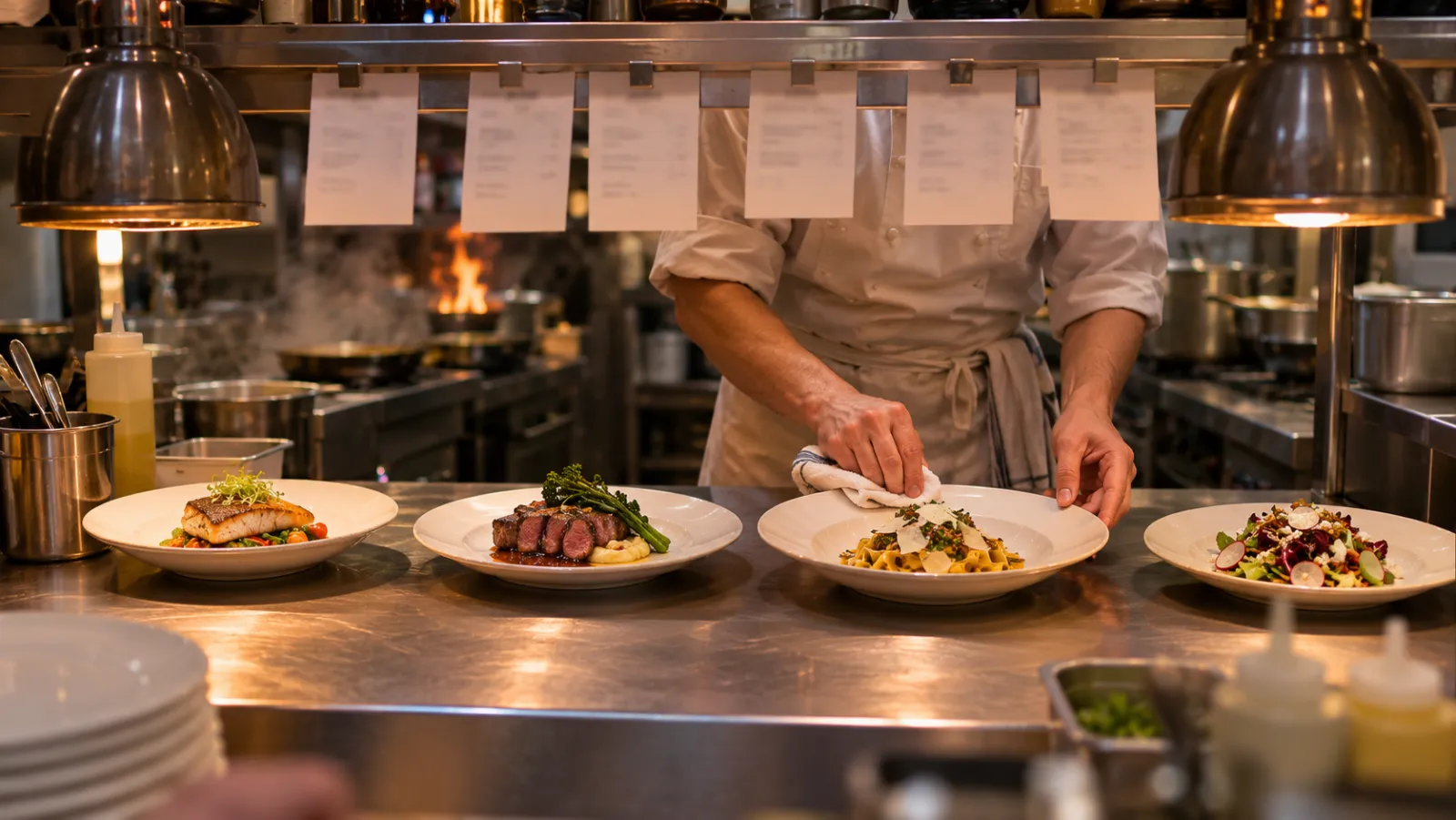
Expo, short for expeditor, is the person who stands at the pass between the kitchen and the dining room and makes sure every plate that leaves is the right one. They read the tickets, call the orders to the line, check each finished dish against what was ordered, and send a table’s food out together, to the right seats.
In a quiet hour nobody needs one. In the rush, expo is what keeps orders straight. When twenty tickets are on the rail, the cooks are watching their own pans, and the servers are watching their own tables. Expo is the only person watching the whole service.
You do not need to hire anyone to have expo. In most small places it is the chef, the owner or a senior cook who steps onto the pass when the rush starts. What you need is a clear routine. This guide covers who should run it, how to set up the pass, the calls and checks that catch mistakes, and the habits on both sides of the pass that stop orders going wrong in the first place.
What expo is, and why the rush needs it
The job is to be the link between the front of house and the back of house (Tasting Table, July 2025). Most kitchens use “expo” for both the person and the spot they stand in. You will also see it spelled expediter.
During service, expo does five things:
- Reads every ticket as it arrives and calls it to the line, so each station knows what is coming.
- Paces the tables. Expo tells cooks when to fire the next course and holds dishes that would otherwise be ready too early.
- Checks every plate against its ticket before it leaves: the right dish, the right changes, the right garnish, the allergy handled.
- Puts the table together. No plate goes out until everything for that table, or that course, is up.
- Hands the food to whoever carries it, with the table and seat numbers, so nobody stands at a table asking who had the chicken.
It is also where news travels. When a dish runs out, expo tells the floor. When a server has a change, an allergy or a guest in a hurry, expo tells the line.
Why the rush? Because that is when everyone else stops seeing the whole picture. A cook with six pans going sees six pans. A server with four tables sees four tables. Somebody has to look at the whole service at once, or mistakes slip through.
Where orders go wrong in a rush
Most wrong plates are not cooking mistakes. They start earlier or later than the stove. Even large chains with headsets, screens and scripts miss: in Intouch Insight’s 2025 study of 13 US fast-food drive-thru brands, the best brand got 96% of orders right, and several of the biggest scored 87 or 88%, roughly one order in eight wrong (Intouch Insight, 1 October 2025). A small restaurant on a Friday night has fewer systems and more changes per plate.
Here is where orders actually break, and who can catch it:
| Where it breaks | What it looks like | Who catches it |
|---|---|---|
| Taking the order | Wrong item tapped, change forgotten, seat not noted | The server, with a read-back |
| Sending the order | Order taken but not sent, or sent twice | The server; expo notices a table with no ticket |
| The ticket | A change written as a vague note, an allergy buried in a note | Expo, on reading the ticket |
| The line | Wrong temperature, missed change, dish forgotten on a busy station | Expo, at the plate check |
| The pass | A plate goes to the wrong table, or a table goes out half done | Expo, by putting tables together |
| The runner | Right table, wrong seat; food auctioned at the table | Expo, by calling the seat numbers |
| Changes after the send | An add-on or a cancellation never reaches the kitchen | The server and expo, together |
Two things stand out. Most of these mistakes happen at a handoff, not at the stove. And expo can catch most of them, but only if the ticket is clear and the server sent the order properly. A good pass cannot fix a bad order.
Who should run expo
The right answer depends on how many people cook and how many tables you seat.
- Coffee counter or café. The barista calling drinks and checking the name on the cup is doing expo. You need a fixed hand-off spot and a habit of reading the order back before the cup goes over, not an extra person.
- Food truck. The person at the window is expo. Order numbers do the work that table numbers do in a dining room: call the number, check the order against the ticket, hand it over.
- Small restaurant, one hot line. The chef or owner runs the pass during the rush and cooks the rest of the time. Expo duties often fall to the head chef in smaller kitchens (Tasting Table), which keeps quality control with the person who set the standard.
- Several stations or 60-plus seats. A dedicated expo earns their pay here. Their job is to stand still, read and talk, while the chef cooks.
Whoever it is, three rules hold:
- One person, one voice. If the chef and a manager both call tickets, cooks hear two orders. Pick one person per service and tell the team who it is.
- Expo knows the menu cold. They must spot a missing garnish, a wrong sauce or a burger that came medium instead of medium rare. A new hire can run plates; it takes someone experienced to run the pass on a busy night.
- Expo does not cook. The moment the expeditor picks up a pan, nobody is watching the pass. In a two-cook kitchen that is not always possible, so agree in advance which tasks expo may take (finishing garnishes, a sauce, plating desserts) and which never.
Setting up the pass
The pass is the shelf or counter where finished plates wait, usually under heat lamps, between the line and the dining room. The metal strip above it that holds tickets is the rail, and in many kitchens the opening itself is called the window (WebstaurantStore kitchen slang, updated March 2024).
Lay it out before service, not during it. A working pass has:
- Tickets where expo can read them: a rail, or a kitchen screen at eye level. The oldest ticket always sits at the same end.
- Enough hot shelf for your biggest table plus one more. If a ten-top does not fit, it goes out in pieces.
- Finishing kit within reach: garnishes, sauces in squeeze bottles, lemon wedges, cutlery for shared plates, side bowls, clean cloths to wipe rims.
- Allergy markers: a coloured pick, a flag or a separate plate type, so an allergy plate is visible from across the kitchen and travels on its own.
- A clear runner side. Runners and servers pick up from the dining-room side and never reach into the kitchen side.
- A pad and pen, for remakes, notes and the night your printer or screen stops.
Where the pass sits is decided long before anyone works it. If you are still drawing the room, put the pass between the line and the shortest route to the dining room, with space for two runners to stand without blocking a server. The restaurant floor plan guide covers the clearances.
Getting the order right before it reaches the kitchen
Expo can only check a plate against the ticket. If the ticket is wrong, the check passes and the guest still gets the wrong dish. So the front of house does half the work of keeping orders straight.
Number the seats
Pick a fixed point in the room, usually the kitchen door or the food window, and number every table and every seat from it. Seats usually run clockwise from the one marked as seat 1. When the server enters each dish against a seat, expo can call “Table 33, seats 1 and 2” and the runner knows exactly where each plate goes. Properly executed, there is never any “auctioning” of food at the table (St. Louis Magazine, updated February 2025).
Read the order back
At the table, read back anything with a change, every allergy and every steak temperature. It takes ten seconds and catches the mistakes no kitchen can catch later.
Changes as modifiers, not notes
“No onion”, “oat milk” and “dressing on the side” should be buttons on the order screen, printed under their dish, not free-text notes typed in a hurry. Notes are for what the menu cannot predict. The kitchen order ticket guide covers how a ticket the line can read is laid out, how to mark modifiers and how to flag allergies.
Send as you go, and send once
An order taken and not sent is the most common lost order in a rush, because the kitchen cannot make what it never received. Send each course as soon as it is taken. If the guests add a round, add it to the same check and send it as a new ticket, clearly marked as an add-on, rather than re-ringing the whole order.
Running the pass during the rush
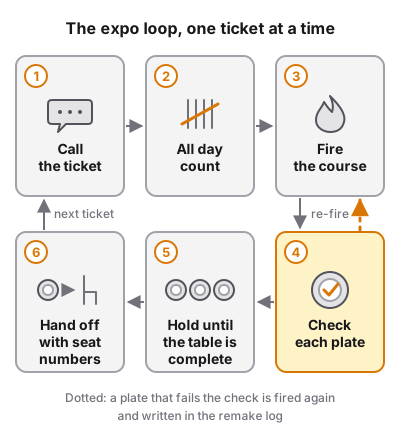
When the rush is on, expo works in a loop. Every ticket goes through the same steps.
1. Call the ticket
Expo reads each new ticket aloud to the line: table, course and the dishes, with the changes. Each station answers “heard” to show it got it (WebstaurantStore). No “heard”, no assumption: say it again.
2. Give the all day
“All day” means the total of a dish across every open ticket. “Four burgers all day” tells the grill cook how many patties to have going, so the station cooks in batches instead of ticket by ticket. Call the all day count when a new ticket changes it, and whenever a cook asks.
3. Fire on time
Expo decides when each table’s next course is fired. Watch the dining room or ask the server: when the starters are nearly finished, fire the mains. In a kitchen with long and short cook times, expo also tells the quick stations to wait, so the fries are not sitting while the steak rests. The kitchen order ticket guide covers how hold and fire are marked on a ticket and how to measure ticket times.
4. Check every plate
Before a plate leaves, compare it with the ticket, line by line:
- Is it the right dish, with every change on the ticket?
- Is it cooked the way it was ordered?
- Is it plated to your standard, rim wiped, garnish on?
- If there is an allergy, was it made and plated separately, and is it marked?
5. Put the table together
Hold every plate for a table, or a course, until all of them are up, then send them out at once. Sending three of four mains “while they are hot” means one guest watches the others eat.
6. Hand it off with the seats
Call the runner with the table and seat numbers, and say any allergy out loud as the plate is handed over. Then take the ticket down or mark it done, so it does not get made twice.
When you are in the weeds
“In the weeds” means falling behind and struggling to keep up. When it happens to the whole kitchen, expo’s job is to slow the inflow, not to shout louder:
- Tell the floor to pause seating or to warn new tables about the wait.
- Call the all day again so every station resets its count.
- Pull the oldest ticket forward and finish tables in order. A table that has waited 40 minutes comes before one that has waited ten, even if its food is harder.
- Tell servers which tables are running late, so they can talk to guests before guests complain.
Changes, remakes and the 86
The rush is when changes hurt most, because every interruption costs a cook time.
Changes after the send
Any change to an order already in the kitchen goes through expo, never straight to a cook. The server makes the change in the system or on a new ticket, clearly marked, and tells expo. Expo tells the station. A cancellation the kitchen does not hear about is a plate cooked for nobody; an add-on nobody hears about is a guest who waits.
Remakes
When a plate comes back, expo calls the remake as a priority, with the reason (“re-fire, burger should be medium rare”), and writes it down. Keep a simple remake log on the pass:
| Time | Table | Dish | What was wrong | Where it went wrong |
|---|---|---|---|---|
| 19:42 | 12 | Burger | Overcooked | Line |
| 20:05 | 7 | Pasta | No-nut order sent with nuts | Ticket (note, not modifier) |
| 20:31 | 21 | Salad | Went to table 12 | Runner, no seat call |
The last column is the useful one. After a week, it tells you whether your problem is the line, the ticket or the floor.
The 86
When a dish runs out, it is 86’d (WebstaurantStore). The kitchen tells expo the moment it knows, expo tells the whole floor at once, and the dish is taken off whatever the servers order from. Better still, have the line warn expo early (“six portions left”), so servers stop recommending it before it is gone. The worst 86 is the one a guest hears after ordering.
Before and after the rush
Most rushes are won or lost in the half hour before the doors open.
Before
- Hold a five-minute pre-shift meeting. Name the expo for the night, go through specials and anything that is low, and say which tables have big parties booked.
- Check prep against the expected covers, station by station. A station that runs out of prepped garnish in the middle of the rush stalls every ticket that needs it.
- Test the tools. Print a test ticket or send a test order to the kitchen screen. Check that each tablet or phone that takes orders is charged and signed in.
- Set the pass: plates warming, garnish kit full, rail empty, pad and pen in place.
- Agree the order of tables: if a large party arrives at 19:30, decide now who else gets fired first.
After
- Spend five minutes on a debrief with whoever ran expo and the chef. What came back? Where did tickets pile up? Which dish slowed the line?
- Read the remake log and look for patterns over a week, not a night.
- Fix the cause, not the person. If one dish keeps going out wrong, change the modifier buttons, the plating instruction or the prep, so the next rush is easier.
A rush-ready checklist
Print it and pin it by the pass.
- One named expo for the service, and the whole team knows who
- Every table and seat numbered from one fixed point
- Servers read back changes, allergies and temperatures at the table
- Common changes are modifiers on the order screen, not notes
- Orders are sent as soon as each course is taken; add-ons are sent as add-ons
- Every ticket is called to the line and answered “heard”
- All day counts called when a new ticket changes them
- Every plate checked against the ticket before it leaves
- Tables leave complete, never in pieces
- Runners are given table and seat numbers, and allergies out loud
- Changes after the send go through expo, never straight to a cook
- 86’d dishes are announced to the whole floor at once
- A remake log sits on the pass, and it is read after service
- Printer or kitchen screen tested before doors open; pad and pen at the pass