A food truck POS system that fits in your hand
Take the order at the window on a phone you already own, send it to the person cooking two feet behind you, and call the number when it is up. It is a point of sale for food trucks with no till to bolt down, no floor plan to invent, and no card processor to sign with.
What a food truck POS has to do that a restaurant POS does not
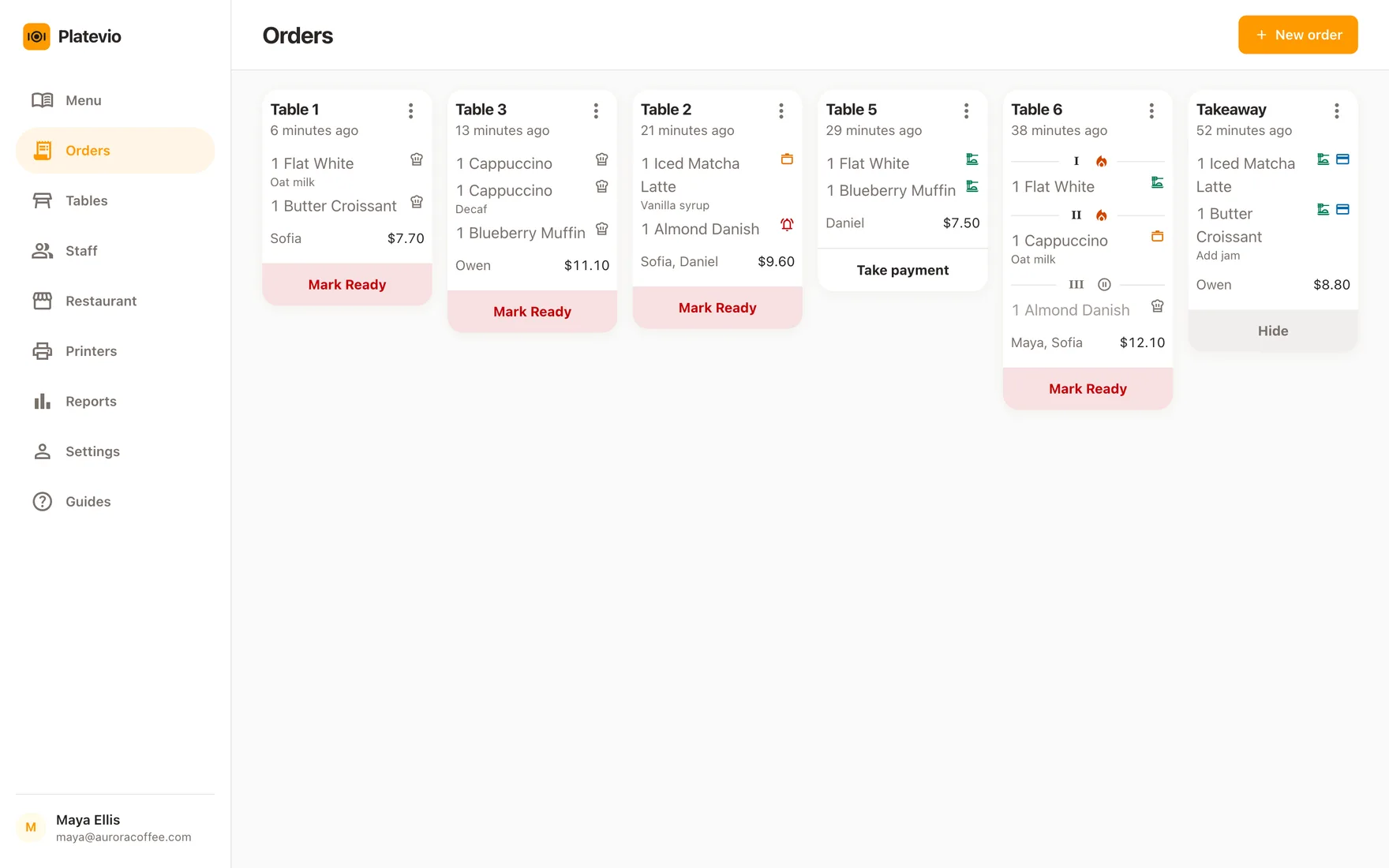
A truck is a kitchen with a queue attached and about four square feet of counter. There is no host stand, no floor plan, no back office and usually no spare outlet, and the person taking the order is often the person handing it out forty seconds later. A restaurant POS is designed around a room: tables, sections, a station per area, and a bill that stays open while people sit. Almost none of that survives the move to a truck. What is left is the part that actually matters at a lunch stop — the order, the modification somebody shouted at the window, what is cooking, what is up, and who has paid — and the hardware it runs on has to be something you can carry between the commissary and the pitch without a trolley. Platevio is built for exactly that: it runs on the phone in your pocket, over the hotspot that phone already carries or the venue’s wifi, and the order is the whole of what it asks you to set up.
The queue is standing in front of you the whole time
A truck has no seat numbers and nothing to write a ticket against, so every order is an anonymous one in a line of anonymous ones — and the line can see how long it is taking. What goes wrong is not the taco, it is the "no onions" on the second one, the order that has been sitting ready for four minutes because nobody knew whose it was, and the two people who both think they are next. Platevio gives every order a short number your window can read out, and each physical unit inside it moves through ordered, preparing, ready and served on its own. So the person cooking and the person at the hatch work off one record rather than two memories — what one of them changes is on the other’s screen without either of them reloading — and both can answer the only two questions a queue ever asks: is mine started, and is mine up?
What Platevio gives a food truck
Seven things, all of them about a service with no counter to put anything on.
-
It runs on the phone already in your apron
A phone, a tablet or a laptop with a current browser, on a hotspot or the venue’s wifi. That is the whole hardware list. Nothing is bolted down, nothing is proprietary, and adding a second screen for whoever is cooking costs whatever the device costs, because it is a web address rather than another station bought from us. Each of the crew signs in with a login of their own — Owner, Administrator, Manager, Waiter or Cook — every device reads the same service off one server, and each change reaches the rest without anybody touching them.
-
An order that never asks which table
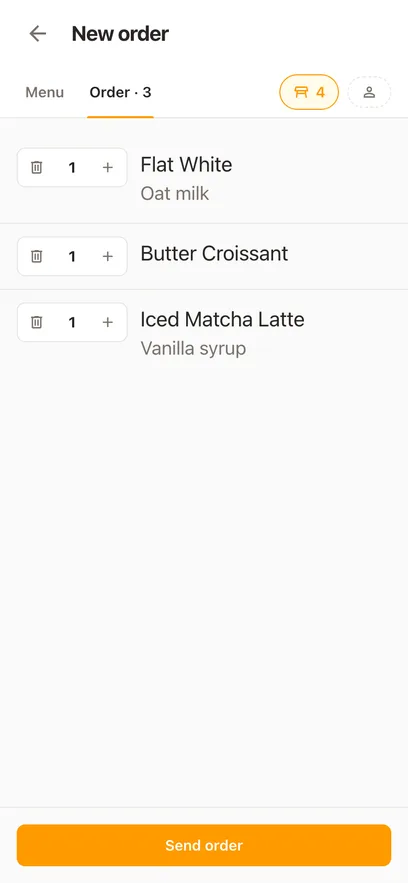
Leave the table off and the order stands on its own. Platevio can run a floor plan for the venues that have one, but a truck is not made to invent a dining room before it can sell lunch.
-
Every order carries a number you can call
Each one gets a short, human number of its own — the counter runs per restaurant, so it stays short — and it is on the order everywhere it is drawn. That is what the hatch calls out, and what the person cooking answers to.
-
Extras and the note ride with the food
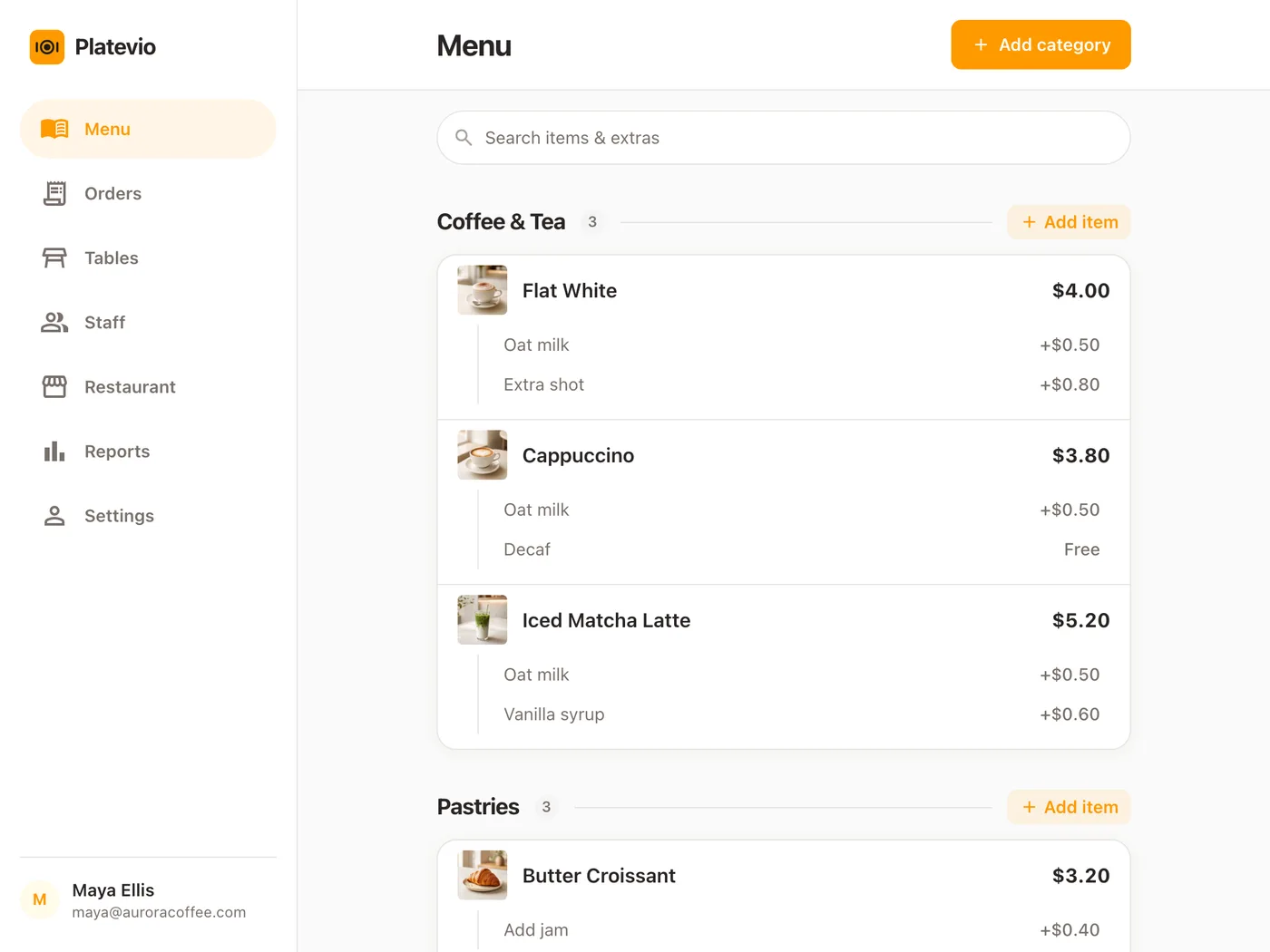
"No onions." "Extra sauce." "Sauce on the side, it is for a kid." A priced extra and a free-text note both sit on the one unit they are about, so the change made at the window is attached to that unit when it reaches the person cooking, rather than shouted across the truck.
-
Two of the same thing move separately
Every physical unit has its own state, so one of the three tacos can be ready while the other two are still on. Mark one ready too early and you can walk it back down to preparing, and a unit cancelled by mistake can be put back on the ladder, instead of starting a second order to fix the first.
-
The card reader you already chose
Record what settled each item — cash, card, cheque, meal voucher or a method you named yourself — while the card itself goes through the reader you picked for your ticket size. No percentage of it comes to us, because the money never passes through us. And when two people in line are paying for one order, the check splits by item, so each of them settles their own tacos and the order still closes as one.
-
Receipts and kitchen tickets, on your own printer
Platevio prints to thermal printers over WiFi, Ethernet, USB and Bluetooth — ESC/POS and Star Micronics — so a customer who wants paper gets it. Nothing is proprietary and nothing is rented from us: bring the printer that already fits the truck and run it from the phone taking orders at the window.
One order, window to hand-off
A lunch stop at half twelve, with eleven people in line and two of you in the truck.
-
12:31
The order is taken at the window
Three tacos, one of them with no onions, and a drink. No table chosen, so it stands on its own. Sent, and it comes back as order 47.
-
12:32
The cook picks it up on the other device
One service, on the tablet by the flat top as soon as the window sends it rather than kept in a copy of its own. Every unit arrives with its extras and its note attached, and the tacos start moving as they are made.
-
12:35
The drink is up before the food
Each unit goes to ready by itself, so the hatch can see that two of the three tacos are still on and does not call 47 a minute early.
-
12:36
“Forty-seven!”
The number is on the order wherever it is drawn, so whoever is at the hatch calls it without asking who ordered what.
-
12:37
It is paid for and it is off the board
The card goes through your own reader; Platevio records that it was settled and how. Then the finished order is hidden by hand, and the board is back to the ten people still waiting.
How to choose a POS for a food truck
Test it in the truck, not at a desk — on the smallest screen you will actually carry, in the glare, on the hotspot you actually trade on. Take a modified order, change an item after it was sent, find which order is up next, mark something sold out, and take a payment, all while somebody times you. The best POS for a food truck is the one that is fastest at the window with the crew you have, not the one that demos best at a desk. Then ask the questions that decide what it costs.
- Does it run on the phone and tablet you already own, or on hardware it sells you?
- Can the crew mark an item sold out from the window, on every device at once?
- What has to be plugged in, and how much counter does it need?
- Is the software tied to one payment processor?
- Can the menu change from stop to stop without rewriting the orders already taken?
- Can the crew tell which order is up without a second tool?
- What does another device, another screen or another pair of hands cost?
Food truck POS questions
- Do food trucks need a POS system?
- Once somebody is always asking whose order is next, yes. What a POS buys you is that the order, the modification, what is cooking and what has been paid for are one record instead of four places, and that record is what a queue of eleven runs on. Most food truck software bundles that record with card processing and a customer app you pay for whether you use them or not; Platevio is the record on its own, free, and you keep the rest of your choices.
- Can I use my phone as a food truck POS?
- Yes. Platevio runs in a current browser on the phone, tablet or laptop you already own, and a second device is a second browser tab rather than another station to buy. The same login works on the tablet by the flat top, and the app speaks 26 languages, so each of the crew reads it in their own.
- Is Platevio a food truck cash register?
- Platevio is the order, the receipt and the till reading, and it lets you keep the cash box and the card reader you already have. It holds the items, the extras chosen on each one, the note, what is cooking and how each unit was settled. It prints the receipt on the thermal printer you brought, over WiFi, USB or Bluetooth, and at the end of the night the report shows what the truck took, by cash and by card, per business day. What Platevio replaces is the notepad, and it does the register’s paperwork on the way.
- What happens when I sell out of something mid-stop?
- Flip the item’s Available to order switch on the menu and it is off the picker on every device in the truck, live, without anybody reloading. The item keeps its place and its price, so the orders that already bought it are untouched, and when the next batch is ready you flip it back on. Extras and notes stay on the item the whole time.
- How do card payments work on a food truck with Platevio?
- Take the card on the reader you already have, then record in Platevio that the order was settled by card. The money goes through your reader and your processor, chosen on your own ticket size, so no percentage of your sales comes to us. Cash, cheque, meal voucher and any method you name yourself are recorded the same way, and the payments report shows what came in by each method.
- Can it run without a table map?
- Yes. An order does not need a table, so a truck never has to build a floor plan to sell anything. Platevio keeps a floor plan for the venues that want one, and a truck simply never opens it: the order is created, numbered and sent from the window, and the board reads the number instead of a seat.
- Can I print receipts and kitchen tickets from the truck?
- Yes. Platevio prints receipts and kitchen tickets to ESC/POS and Star Micronics thermal printers over WiFi, Ethernet, USB and Bluetooth, from the same phone that takes the order. A Bluetooth printer on the shelf by the flat top gets every ticket the window sends, and a customer who wants paper gets a receipt with each item, its extras and what it was settled with.
- How do I see what the truck took at a stop?
- The reports show sales, orders and what is still unpaid per business day — a day runs six in the morning to six the next, so a late pitch stays on the day it belongs to — and what came in by cash, card and every other method. Every number opens to the checks behind it, so the figure on the report and the receipts in the box agree before you drive off.
- How much does a food truck POS system cost?
- Count more than the software: the compact hardware, the card processing, and whatever is charged per extra device or per location. Platevio is free to use, with no card and no plan, runs on the devices you already own, charges nothing per device, screen or user, and takes no percentage of your sales. The card reader you already pay for stays the only payment bill.
Open your restaurant tonight
It takes a minute: your restaurant, your first menu, and you are taking orders.