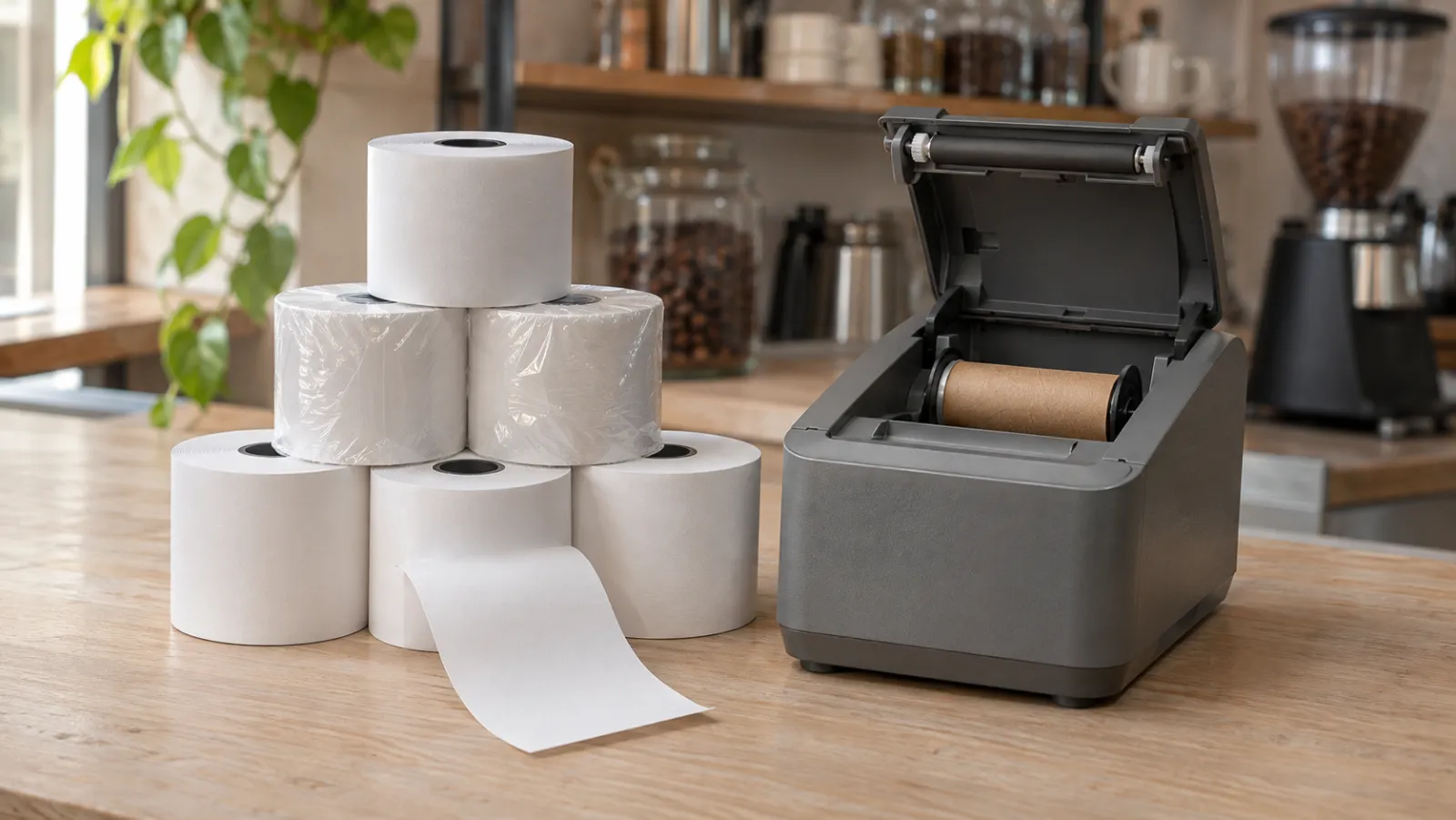
Receipt paper is the roll inside your receipt printer: a strip coated on one side with chemicals that turn dark when the print head heats them. There is no ink and no ribbon, so the roll is the only thing the printer uses up. In the UK it is sold as till rolls, in Australia as thermal rolls, docket rolls or EFTPOS rolls, and in the US and Canada as receipt paper, register rolls or POS rolls.
Buying the right roll comes down to three numbers: the width, which must match the printer; the size of the roll, which must fit inside it; and the length of paper on it, which decides how many receipts you get. US and Canadian sellers write the size as width by length in inches and feet (3 1/8” x 230’). British and Australian sellers write width by roll diameter in millimetres (80 x 80 mm). Mixing the two up is the most common buying mistake.
A receipt gone grey by the grill is rarely the printer’s fault. It is the paper, or how it was kept. If you are still choosing the printer itself, start with the thermal receipt printer guide: it decides which paper you will buy for years.
What receipt paper is
Thermal paper has a coating that holds a colourless dye and a developer. When the print head heats a dot, the two react and the dot turns dark. The US Environmental Protection Agency describes the developer’s job exactly that way: it reacts with colourless dyes and, under heat, turns them dark. That chemistry explains three things every owner runs into:
- It prints on one side only. Load a roll upside down and the receipt comes out blank.
- Heat darkens it. A grill shelf or a dashboard in summer can turn it grey without the printer touching it.
- You can test it with a fingernail. Scratch the shiny side hard and the friction leaves a grey line. Plain paper does nothing.
Thermal or bond: check before you buy
Some kitchens use impact (dot-matrix) printers that strike an ink ribbon onto plain paper, because they cope with the heat by the line. Those take bond rolls, not thermal ones. The manual for one common impact kitchen printer, the Epson TM-U220, specifies rolls 76 mm, 69.5 mm or 57.5 mm wide. Thermal paper is wasted on a ribbon printer, and bond paper prints nothing in a thermal one.
| Paper | Printer | Needs | Usual width |
|---|---|---|---|
| Thermal, one ply | Thermal receipt or kitchen printer | Nothing else | 80 mm (3 1/8”) or 57–58 mm (2 1/4”) |
| Bond, one ply | Impact kitchen printer | An ink ribbon | 76 mm (3”) |
| Two-ply carbonless | Impact printer that prints a copy | An ink ribbon | 76 mm (3”) |
Receipt paper sizes, by country
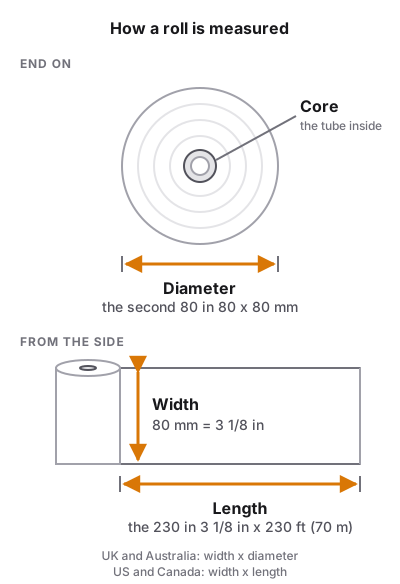
Every roll has four measurements: width, outer diameter, core (the tube in the middle) and length of paper on it. Sellers print two of them, and which two depends on where you buy.
US and Canada: inches by feet
The first number is the width in inches, the second the length of paper in feet. A 3 1/8” x 230’ roll is 79.4 mm wide with 230 feet (70.1 m) of paper. One Canadian listing of that size gives a diameter of about 2 3/4” on 48 g/m² paper.
- 3 1/8” is the standard for counter and kitchen thermal printers. Common lengths are 200’, 220’, 225’ and 230’.
- 2 1/4” is for card terminals and small portable printers. Common lengths are 50’ and 85’.
- 3” is bond paper for impact kitchen printers.
UK and Australia: millimetres by millimetres
The first number is the width in millimetres, the second the outer diameter of the roll, not its length. An 80 x 80 till roll is 80 mm wide and 80 mm across.
- 80 x 80 is the everyday roll for counter and kitchen thermal printers in both countries. 80 x 70 and 80 x 60 are smaller rolls of the same width.
- 57 x 40 and 57 x 38 fit card machines (PDQ in the UK, EFTPOS in Australia) and small portables.
- 76 x 76 is bond paper for impact kitchen printers.
Some shops add a third number, the core (80 x 80 x 12.7 mm), or the length in metres. If a listing puzzles you, the width is the number that looks like 57, 58, 76, 79 or 80.
The same rolls, side by side
| Job | US and Canada | UK and Australia |
|---|---|---|
| Counter and kitchen thermal printer | 3 1/8” x 230’ | 80 x 80 mm |
| Smaller 80 mm roll | 3 1/8” x 200’ | 80 x 70 mm or 80 x 60 mm |
| Card machine or portable printer | 2 1/4” x 50’ | 57 x 40 mm or 57 x 38 mm |
| Impact kitchen printer | 3” bond | 76 x 76 mm bond |
The pairs are near equivalents for the job, not exact matches: a 3 1/8” x 230’ roll and an 80 x 80 roll may carry different lengths of paper.
Which roll fits your printer
Find three figures in your printer’s manual or spec sheet: paper width, maximum roll diameter and core size. As an example, the technical reference for the Epson TM-T20III, a common entry printer, lists:
| Figure | Value in the manual |
|---|---|
| Paper width | 79.5 ± 0.5 mm (3.13”) for 80 mm paper, or 57.5 ± 0.5 mm (2.26”) for 58 mm |
| Maximum roll diameter | 83 mm (3.27”) |
| Core | 12 mm inside, 18 mm outside |
So an 80 x 80 or a 3 1/8” x 230’ roll fits that printer, but a roll wider across than 83 mm does not. Card terminals take much smaller rolls, and some take a 57 x 38 but not a 57 x 40, so read the terminal’s own spec sheet for its maximum diameter.
Mistakes that cost a box of paper
- The wrong width. An 80 mm roll will not fit a 58 mm printer, and a 58 mm roll in an 80 mm printer wanders unless the printer has a 58 mm guide fitted and is set to it. On the Epson example, the switch from 80 to 58 mm paper is one-way.
- A roll too fat for the cover. The lid will not close, or the paper drags and jams.
- Thermal and bond mixed up. Either way round, nothing useful prints.
- Reading 80 x 80 as length. In the UK and Australia it is diameter. A roll described as “80 mm x 80 m” is a different statement.
Loading a new roll
- Put it in so the paper comes off with the coated side facing the print head. Most printers have a diagram inside the cover.
- Use rolls whose paper is not glued to the core. The Epson manual says not to use them, because the printer cannot pull the last of the paper free.
- Many printers have a near-end sensor that warns before the roll runs out. On the Epson example it is off by default. Turning it on is the cheapest way to avoid a blank ticket mid-service.
- The same manual recommends a print density setting per paper grade. If prints look pale on a new brand of paper, check that setting before blaming the roll.
How long a roll lasts
How many receipts you get depends on two numbers: the length of paper on the roll and the length of your receipt. If the box says the length, use it. If it only gives the diameter, estimate it:
Length ≈ π × (D² − d²) ÷ (4 × t), where D is the roll diameter, d the core’s outside diameter and t the paper thickness, all in millimetres.
With an 18 mm core and paper 0.06 mm thick, the formula gives these lengths. One UK supplier quotes 75 to 80 m for an 80 x 80 roll of standard 55 g/m² paper, which matches.
| Roll | Paper on it | Kitchen tickets of 4” (10 cm) | Bills of 6” (15 cm) |
|---|---|---|---|
| 3 1/8” x 230’ | 70 m (stated) | about 690 | about 460 |
| 2 1/4” x 50’ | 15 m (stated) | about 150 | about 100 |
| 80 x 80 mm | about 80 m | about 800 | about 530 |
| 80 x 70 mm | about 60 m | about 600 | about 400 |
| 80 x 60 mm | about 43 m | about 430 | about 290 |
| 57 x 40 mm | about 17 m | about 170 | about 110 |
The estimated rows are examples for paper of that thickness. Thinner paper puts more metres on the same diameter, thicker paper fewer. Measure your own receipts: print a typical kitchen ticket and a typical bill and hold a ruler to them.
Same size, different amount of paper
Two “80 x 80” rolls can carry very different lengths. The same UK supplier warns that a budget “80 m” roll on thick paper can come in at 60 m. In the US, one marketplace listing sold as “3 1/8 x 230” gives the actual size in its title as 80 mm by 46 m, about 150 feet. Compare boxes by total metres or feet, not by roll count.
How many rolls you need a month
Work it out once, then order by the box. A worked example with invented numbers:
US café, 150 orders a day, open 30 days a month. Each order prints one 6” receipt and one 4” kitchen ticket.
- Paper per day: 150 × (6” + 4”) = 1,500 inches, which is 125 feet.
- Paper per month: 125 × 30 = 3,750 feet.
- Rolls of 3 1/8” x 230’: 3,750 ÷ 230 ≈ 16.3, so 17 rolls.
- Add 20% for reprints, test pages and rolls changed early: about 20 rolls, so a 50-roll case lasts about two and a half months.
UK bar, 150 orders a day, open 30 days. A 15 cm bill and a 10 cm bar ticket per order is 37.5 m a day, or 1,125 m a month. With 80 x 80 rolls of about 78 m that is 15 rolls, about 18 with the margin: roughly one box of 20 a month.
What it costs
Prices from retailer pages read on 5 November 2026, each in its own market’s currency. They move often, so treat them as a guide, not a quote.
| Market | Example | Price seen |
|---|---|---|
| US | 3 1/8” x 230’, 50 rolls (WebstaurantStore) | $57.99 a case |
| US | 3 1/8” x 230’, 50 rolls, BPA-free (Thermal Paper Direct) | $67.90 a case |
| US | The same roll, phenol-free (Thermal Paper Direct) | $93.90 a case |
| UK | 80 x 80 mm thermal till rolls, box of 20 (Pronto Direct) | £16.99 inc VAT |
| Australia | 80 x 80 mm thermal rolls, BPA-free, 8 pack (Officeworks) | $43.00 |
| Australia | 80 x 80 mm coreless thermal rolls, 24 pack (Officeworks) | $79.00 |
Canadian stores sell the same inch sizes, but we could not read a Canadian price page that day, so ask your local supplier. For the US café above, 20 rolls a month at $58–$94 per 50 comes to roughly $23–$38 of paper. The cheapest case is not always the cheapest paper: see the length trap above.
Using less paper
- Send each station only its own items. If the bar printer also prints the food, every order uses twice the paper. In most POS systems this is set by menu category.
- Print only what is new on a second round, not the whole order again.
- Ask before printing a receipt where your local rules allow it.
- Consider a kitchen screen for the line. It uses no paper. The trade-offs are in the kitchen order ticket guide.
Why receipts fade
A thermal print is not permanent. Over time the black lightens or the white background greys, and the same causes speed both up. A storage guide from the Japanese instrument maker A&D lists what to keep away from thermal paper:
- Heat. A&D recommends storing it below 25 °C (77 °F). Next to a fryer or on a car dashboard, paper can grey even before it is printed.
- Light, direct sun or a lamp close by, and humidity or water.
- Plasticisers: clear PVC sleeves and folders, vinyl mats, rubber erasers.
- Solvents and alcohol, including hand sanitiser on staff’s hands, and hand cream.
- Tape and correction fluid over the print.
- Rubbing against hard objects, or contact with carbonless paper.
How long a thermal print lasts
Paper makers rate it. The data sheet for Koehler’s KT 48 FA, a common receipt grade, claims ten years of readability with correct storage, and backs it with accelerated tests: how much of the print survives 24 hours at 50 °C, 24 hours at 40 °C and 80% humidity, and 24 hours under 16,000 lux of light. “Correct storage” is the part a restaurant rarely manages.
Kitchen tickets have a harder life. A thermal printer is rated for a working temperature range (5–45 °C on the Epson example), and a shelf above the grill can be hotter than that. Put the kitchen printer at the pass, away from direct heat and steam.
How to store rolls and receipts
Spare rolls:
- Keep them wrapped, in a closed box, out of the light. A&D recommends below 25 °C and below 65% relative humidity, and using the paper within about two years of buying it.
- Never above the hood, beside the oven, or in a hot truck or van in summer.
- Keep one spare at every printer, and open the oldest box first.
Printed receipts you need to keep:
- Somewhere cool and dark, in paper envelopes or card folders, not PVC sleeves.
- No tape across the print. If they must be stuck down, A&D suggests water-based glue.
- Never rely on the thermal receipt as your only copy. A&D itself recommends copying anything important. Keep end-of-day totals in your POS records, a scan or a photo as well.
BPA, BPS and phenol-free paper
Many thermal papers once used bisphenol A (BPA) as the developer, and some still do. The concern is skin contact for people who handle receipts all shift. Health Canada calls skin contact from handling thermal paper “an important secondary route” of BPA exposure, behind food.
What the rules say, as of November 2026:
- UK and EU. Since 2 January 2020, thermal paper containing BPA at 0.02% or more by weight may not be placed on the market (Regulation (EU) 2016/2235, an amendment to REACH). The same text remains on the UK statute book.
- US. We found no nationwide ban. Some states have their own: Connecticut, for example, bans making, selling or distributing thermal receipt paper that contains BPA.
- Canada and Australia. We found no rule specific to receipt paper. The choice is the buyer’s.
BPA-free is not the same as phenol-free
A common replacement for BPA is bisphenol S (BPS), a close relative. One US seller’s “BPA-free” 3 1/8” x 230’ case, for example, carries a California Proposition 65 warning that it can expose you to BPS. The US EPA’s review of BPA alternatives found no developer of low concern on every hazard it assessed. So “BPA-free” on a box may still mean another bisphenol.
Phenol-free paper uses a developer that is not a phenol at all. Koehler’s KT 48 PF, for example, is described as produced without phenols, and the same US seller lists a version free of BPA, BPS and other phenols. If your staff handle receipts all day, ask your supplier for the data sheet and pick one that names its developer or states phenol-free. In the price table above it costs about a third more.
Buying checklist
- Width matches the printer: 80 mm (3 1/8”) or 57–58 mm (2 1/4”).
- Roll diameter is under the printer’s maximum.
- Core matches, and the paper’s end is not glued to it.
- Thermal for a thermal printer, bond for an impact printer with a ribbon.
- Length per roll is printed on the box, or estimated with the formula.
- Price compared per metre or foot, not per roll.
- BPA-free, or phenol-free if staff handle receipts all shift.
- A month’s stock worked out, plus 20%.
- Stored cool, dark and dry, nowhere near the kitchen heat.
- One spare at every printer, and the near-end warning switched on.
Fitting out a whole kitchen? See the commercial kitchen equipment list.